
Brooklyn Bridge Facts: The Complete Walking Tour Guide (History, Tips & Hidden Stops)

The Brooklyn Bridge and DUMBO Neighborhood: A Comprehensive Guide to New York City’s Iconic Landmarks
Everyone wants the photo, but most people get the crowd. If you're standing on the bridge at 11:00 AM, you're not seeing history—you're weaving through a steadily growing sea of people - and now - being hurried through. Here is how to actually 'see' the bridge.
Can you join a Brooklyn Bridge tour with a local? Yes. Vibe NYC Tours offers native-led Brooklyn Bridge walks that focus on the Roebling family's engineering secrets and the "86" stories of the neighborhood.
The Brooklyn Bridge and the DUMBO neighborhood are iconic symbols of New York City, attracting millions of visitors each year. This comprehensive guide will explore the historical significance of the Brooklyn Bridge, the best walking routes and tours available, top photo spots, hidden gems, and family-friendly experiences in DUMBO. Whether you're a first-time visitor or a seasoned local, this guide will help you uncover the rich history and vibrant culture of these landmarks. As you navigate through this article, you'll discover practical tips and insights to enhance your experience while exploring the Brooklyn Bridge and DUMBO.

Important: New Pedestrian Flow Zones Implemented Ahead of 2026 FIFA World Cup
Heading into the Summer of 2026, the Brooklyn Bridge has implemented new pedestrian flow zones, ahead of the 2026 FIFA World Cup. The city is redesigning the Manhattan entrance to the Brooklyn Bridge to alleviate severe pedestrian and cyclist congestion.
Pro Tip: The 'Selfie Bottlenecks' are now strictly monitored near the towers. If you want that centered shot without a fine or a nudge, you need to be at the Brooklyn tower by 6:15 AM. It sounds crazy, but you'll be glad you did it, trust.
New Pedestrian Flow Zones: As of late March 2026, Mayor Zohran Mamdani and the NYC DOT announced a redesign of the Manhattan entrance, featuring separate entrances for cyclists and pedestrians, with construction completing by June 2026.
'Selfie Bottlenecks' Monitoring: The redesign specifically targets the "mixing zone" or bottleneck at the Manhattan approach, where massive traffic causes delays, to ensure better, safer, and faster passage.
6:15 AM Pro Tip : While an exact time wasn't mandated by the DOT, the bridge receives over 30,000 pedestrians daily, peaking later in the day. Early morning (sunrise) is notoriously the only time to get clear photos at the towers, especially during busy summer months.
Ferry to DUMBO Alternative: The NYC Ferry service is frequently promoted as a quick and cooler alternative to walking the bridge during high temperatures, particularly for visitors aiming for DUMBO
Go Beyond the View: The Story Continues Across the Street The Brooklyn Bridge is a marvel of 19th-century grit, but the story of New York's resilience didn't stop there. Just a short walk from the Manhattan ramp lies the Financial District and Ground Zero—where the "Vibe" of the city truly lives.
If you want to see the 9/11 Memorial through the eyes of a native New Yorker or walk the cobblestones of Wall Street with a former trader, join me for a personal journey you won't find in a guidebook.
The Historical Significance of the Brooklyn Bridge and Its Architecture
When the Brooklyn Bridge opened in 1883, it did more than connect Lower Manhattan and Brooklyn — it fused two cities, accelerated commerce, and reshaped New York’s destiny.
At the time, Brooklyn was an independent city. The East River, though relatively narrow, was fast-moving, congested with ship traffic, and frozen in winter. Ferries were unreliable and often dangerous. A permanent span was considered bold to the point of folly.
The bridge’s completion signaled something larger than transportation. It embodied the confidence of the Industrial Revolution — the conviction that engineering, mathematics, and steel could overcome geography.
Architecturally, the bridge is both utilitarian and poetic. Its massive granite towers rise in Gothic pointed arches reminiscent of cathedral windows. These arches are structurally efficient — reducing weight and distributing compressive force — but they also create a spiritual silhouette against the skyline. The web of exposed steel cables introduced a new industrial aesthetic: tension and geometry made visible.
At its opening, it was the longest suspension bridge in the world. More than 150,000 people crossed on the first day.
Its impact was immediate:
Property values in Brooklyn surged.
Commuting patterns transformed.
The psychological distance between the boroughs collapsed.
The bridge laid groundwork for the consolidation of Greater New York in 1898. It became not just infrastructure, but identity — a visual shorthand for ambition and resilience.
How Was the Brooklyn Bridge Constructed and Who Were Its Architects?
The bridge was conceived by John A. Roebling, a pioneer in suspension bridge design and steel cable manufacturing. Roebling insisted on using steel wire rather than iron chains, arguing that steel’s superior tensile strength would allow for unprecedented span length and stability.
He died in 1869 after his foot was crushed by a docking ship at Fulton Ferry Landing which led to tetanus, leaving the project to his son, Washington Roebling. This is also the site where George Washington staged the "Miracle Retreat" after the Battle of Brooklyn.
While the Brooklyn Bridge represents the industrial triumph of 1883, the ground it stands on in DUMBO was the site of an earlier, more desperate 'passage.' On the night of August 29, 1776, following the devastating defeat at the Battle of Brooklyn, George Washington staged one of the most improbable military maneuvers in history. At the Fulton Ferry Landing—now the doorstep of DUMBO—Washington and 9,000 Continental troops evacuated across the East River to Manhattan under the cover of a thick, providential fog. Without this retreat, the American Revolution likely would have ended right here on the Brooklyn waterfront. As we approach America 250, walking the DUMBO shoreline isn't just about seeing a bridge; it’s about standing on the exact site where the American experiment narrowly escaped extinction.
Construction began with the sinking of massive wooden caissons — airtight chambers — to anchor the towers to bedrock beneath the river. Workers excavated riverbed sediment under extreme pressure to keep water out. Many developed decompression sickness (“the bends”), including Washington Roebling himself, who became severely debilitated.
Unable to supervise on site, he directed operations from his Brooklyn Heights residence. His wife, Emily Warren Roebling, became the critical liaison. She studied advanced mathematics, materials science, and cable construction to communicate his instructions to engineers and city officials. Her role was so central that she was the first person to cross the bridge upon its completion.
The cables themselves were spun in place — thousands of individual steel wires stretched back and forth across the river, then compacted into massive load-bearing strands. The towers were built from limestone, granite, and Rosendale cement, materials chosen for durability and compressive strength. The result was a hybrid structure: part suspension bridge, part cable-stayed system, incorporating diagonal stays for additional rigidity.
It took 14 years to build. It required technological innovation, political negotiation, and personal endurance. And when it opened, it stood not only as the longest bridge in the world — but as proof that New York intended to build on a scale previously unimaginable.
Key Historical Events That Shaped the Brooklyn Bridge’s Legacy
When the Brooklyn Bridge opened on May 24, 1883, the ceremony itself set the tone for its legacy.
President Chester A. Arthur attended. So did New York Governor Grover Cleveland, who would later become President. Cannons boomed. Church bells rang. Fireworks ignited the skyline. More than 150,000 people crossed the bridge in the first 24 hours — some cautiously, some jubilantly — walking into what felt like the future.
But triumph was followed almost immediately by tragedy. Just six days later, on May 30, 1883, a rumor that the bridge was collapsing triggered a stampede on the pedestrian walkway. Twelve people were crushed to death. Public confidence wavered.
To restore faith in the structure, showman P. T. Barnum famously marched 21 elephants — including Jumbo — across the span in 1884. The message was clear: if the bridge could carry elephants, it could carry New Yorkers.
Over the decades, the bridge became a stage for civic ritual. Victory parades passed over it. Labor protests filled its lanes. During periods of economic hardship and war, its silhouette stood as a constant while the city convulsed around it.
In 1944, workers discovered and removed wartime storage hidden within its masonry vaults — a reminder that even infrastructure can quietly serve national defense. And then there was September 11, 2001.
From the bridge’s elevated promenade, thousands witnessed smoke rising from Lower Manhattan as the World Trade Center burned. In the hours that followed, it became an evacuation route. People walked north across its planks in stunned silence, retracing in reverse the hopeful crossings of 1883.
In that moment, the bridge was not a tourist landmark or photographic icon. It was what it had always been at its core: a passage. A connector. A structural act of resilience. Its legacy is not shaped by a single event, but by repetition — celebration, panic, spectacle, protest, tragedy, endurance.
The Brooklyn Bridge has carried presidents, circus animals, soldiers, commuters, and mourners. It has survived economic depressions, world wars, terror attacks, and relentless traffic. And through each era, its towers have remained fixed against the skyline — less a monument to the past than a working participant in the city’s ongoing story.
Make Your NYC Visit Meaningful
Don't just visit New York—understand it. From the America 250 celebrations to the hallowed grounds of the World Trade Center, let a local show you the real "Vibe" of the city.
Book Your Native-Led Experience Here Small groups. Personal stories. 100% NYC.
Best Routes and Walking Tour Options for Exploring Brooklyn Bridge and DUMBO
Exploring on foot offers a unique perspective of these iconic sites. There are several walking routes and Brooklyn Bridge and DUMBO walking tours available that cater to different interests and time constraints. Whether you prefer a leisurely stroll or a more in-depth exploration, there are options to suit every visitor.
Guided Brooklyn Bridge Walking Tours Available in 2026
In 2026, visitors can choose from a variety of guided walking tours that highlight the history and architecture of the Brooklyn Bridge. Some popular options include:
Brooklyn Bridge Historical Walk: This tour focuses on the bridge's construction and its significance in American history, lasting approximately 2 hours.
Sunset Bridge Walk: A scenic tour that takes place during the golden hour, providing stunning views of the Manhattan skyline and amazing history & stories from a Brooklyn native.
Photography Tour: Tailored for photography enthusiasts, this tour offers tips on capturing the best angles and lighting.
Duration and Inclusions of Typical Brooklyn Bridge Walking Tours
Most guided walking tours of the Brooklyn Bridge last between 1.5 to 3 hours. However, in my opinion, 90 minutes is plenty unless you’re also getting professional photography done (and if you are, get there really early!). These tours typically include:
A knowledgeable guide who shares insights about the bridge's history and architecture.
Stops at key viewpoints for photo opportunities.
Information about the surrounding areas, including DUMBO and its attractions.
Visitors can expect a mix of historical context, architectural details, and personal anecdotes that bring the bridge's story to life.
Top Photo Spots in Brooklyn Bridge and DUMBO for Capturing Iconic Views
There are places in New York where you take a photograph — and places where you capture an icon.
The pedestrian promenade of the Brooklyn Bridge is the first. Walk toward Manhattan just after sunrise, and the city reveals itself slowly through the lattice of steel cables. The Gothic arches frame Lower Manhattan like a proscenium. Stand centered beneath the first set of arches on the Brooklyn side for the classic symmetrical shot: granite towers rising, cables fanning outward in geometric precision, skyline suspended beyond.
Timing matters. Early morning offers softer light and thinner crowds. At sunset, the steel glows warm, and the skyline begins to glitter.
Step off the bridge into DUMBO — Down Under the Manhattan Bridge Overpass — and the mood shifts from monumental to cinematic.
The most famous composition waits at Washington Street between Front and Water Streets. Here, the Manhattan Bridge towers overhead, perfectly framing the Empire State Building in the distance. It’s a shot that feels almost staged — cobblestones in the foreground, steel in the midground, Art Deco spire in the background. Come early; crowds build quickly.
For skyline drama, head to Brooklyn Bridge Park. From Pebble Beach or Fulton Ferry Landing, you can capture the Brooklyn Bridge sweeping across the East River with Lower Manhattan rising behind it. Blue hour — just after sunset — is particularly powerful. The bridge lights trace elegant arcs against the deepening sky.
For something quieter, walk along the river’s edge beneath the bridge itself. Looking upward from the anchorage reveals the muscular underside of the structure — cables, stone, and rivets rendered almost abstract.
DUMBO offers intimacy: brick warehouses, converted industrial lofts, narrow streets that funnel light dramatically between buildings. The Brooklyn Bridge offers scale. Together, they provide contrast — texture and grandeur, steel and stone, skyline and shadow — all within a few walkable blocks.
The secret isn’t just where you stand. It’s when you arrive — and whether you’re looking for symmetry, silhouette, or the feeling of standing inside New York’s most photographed frame.
Best Times and Tips for Photographing Brooklyn Bridge Landmarks
Photographing the Brooklyn Bridge isn’t just about location — it’s about light, timing, and patience.
Best Times of Day
Sunrise is the most rewarding — and the most forgiving. Arrive just before first light, and you’ll watch Lower Manhattan emerge gradually through the bridge’s web of cables. The granite towers glow softly, shadows are long, and foot traffic is minimal. The symmetry shots from the Brooklyn-side arches are far easier to compose without crowds.
Sunset offers warmth and drama. From Brooklyn Bridge Park, the bridge becomes a silhouette against a pink or amber sky. Stay through blue hour — roughly 20–40 minutes after sunset — when the skyline lights turn on, and the bridge’s cables create luminous lines against a deep cobalt sky.
Midday light is harsher and flattens texture. If you must shoot then, focus on architectural details — rivets, cables, and stonework — rather than wide skyline shots.
Practical Tips for Stronger Images
Use a tripod (when permitted): For long exposures at dusk or dawn, stability is essential. It allows you to smooth water in the East River and capture light trails from traffic. (Note: Always follow posted rules about tripods on the pedestrian walkway.)
Vary your elevation: Shoot straight-on for the classic symmetrical cable shot. Then lower your camera to emphasize cobblestones in DUMBO, or tilt upward beneath the arches for dramatic vertical composition.
Incorporate foreground layers: On the bridge, frame your shot with cables or wooden planks. In DUMBO, use brick walls, iron fire escapes, or the Washington Street corridor beneath the Manhattan Bridge to create depth.
Mind pedestrian flow: Cyclists and commuters move quickly. Position yourself near the edge of the walkway to avoid disrupting traffic — and to capture candid human movement that adds scale.
Watch the weather: Light fog can create atmospheric depth. After rain, cobblestones reflect city lights beautifully.
The Brooklyn Bridge rewards those who return more than once. The structure stays the same. The light never does.
Unique Perspectives and Hidden Gems in DUMBO
Yes, Washington Street delivers the postcard view: the Manhattan Bridge perfectly framing the Empire State Building. But the magic of DUMBO lies in the variations.
Walk toward Water Street at golden hour and watch the brick warehouses catch low, directional light. Step beneath the archways of the Manhattan Bridge anchorage and shoot upward — the steel trusses form industrial geometry that feels almost abstract. Few visitors look up.
At Pebble Beach inside Brooklyn Bridge Park, crouch low near the shoreline. The rounded stones create foreground texture, the Brooklyn Bridge sweeps diagonally across the frame, and Lower Manhattan rises beyond. In winter, when trees are bare and crowds thin, the sight lines are even cleaner.
Seek out temporary art installations tucked between warehouse facades. DUMBO’s side streets often host murals, projection art, and sculptural works that shift seasonally. They offer color against the neighborhood’s industrial palette.
And for a quieter skyline view, walk toward Empire Stores’ rooftop terrace. From there, the East River opens wide, and the bridge reads as both infrastructure and sculpture. The iconic shots are easy to find. The layered ones require wandering.
Hidden Gems and Local Favorites in DUMBO Brooklyn
Beyond the camera angles, DUMBO thrives on reinvention. Once a manufacturing district — warehouses storing coffee, machinery, and paper — it has evolved into one of Brooklyn’s most creative enclaves.

Inside a glass pavilion along the waterfront sits Jane's Carousel, a meticulously restored 1922 carousel. Its hand-carved horses spin against a backdrop of steel bridges and skyscrapers — nostalgia framed by modernity.
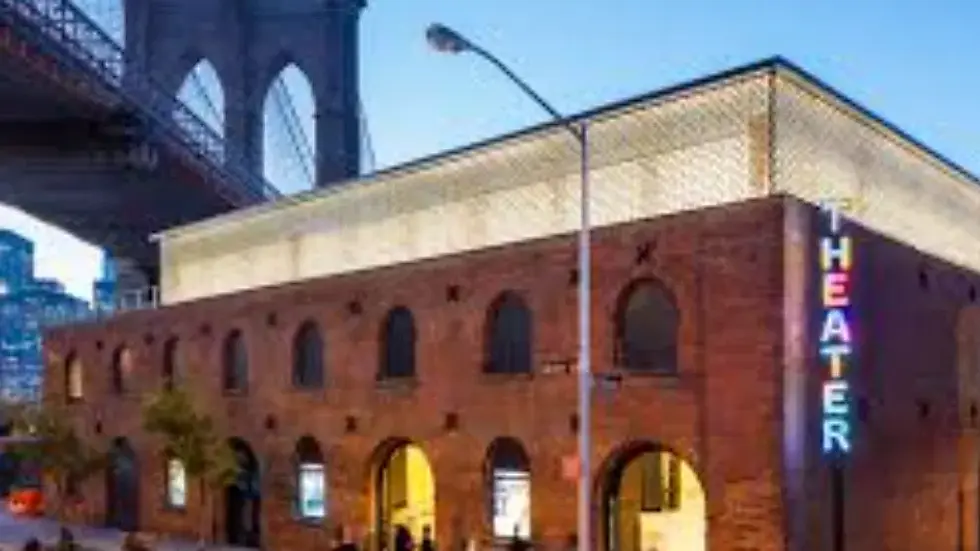
Just steps away, St. Ann's Warehouse occupies a former tobacco warehouse, now a globally respected performing arts venue. Experimental theater, international productions, and avant-garde performances unfold beneath timber beams that once supported industrial labor.
Scattered throughout the neighborhood are small contemporary galleries showcasing emerging artists. Unlike museum spaces, these galleries feel intimate — you are often speaking directly with curators or creators.
DUMBO’s character is layered: cobblestones underfoot, tech startups overhead, art in between.
How Storytelling Narratives Enhance Discovery
DUMBO makes more sense when it’s narrated.
Knowing that the Manhattan Bridge was completed in 1909. Understanding how container shipping reshaped the waterfront. Hearing how artists moved into vacant warehouses in the 1970s and 80s, transforming industrial vacancy into cultural capital. Story turns scenery into sequence.
Guides often connect the bridges overhead with immigration, trade, and urban expansion. They explain how the river functioned as both barrier and lifeline. When visitors understand that these streets once smelled of molasses and machine oil, the polished cafés feel less accidental — more evolutionary.
Stories create emotional architecture. Native, older guides are typically full of stories from the “old days” of DUMBO, and we assure you, it was quite different just 20 years ago.
Family-Friendly and Group Experiences Around the Brooklyn Bridge and DUMBO
The area surrounding the Brooklyn Bridge lends itself naturally to multigenerational exploration.
Family scavenger hunts transform architectural details into clues — spotting Gothic arches, counting suspension cables, tracing cobblestone patterns. Children engage physically while absorbing history almost incidentally.
Art-and-architecture walks combine the bridge crossing with stops in DUMBO’s galleries and waterfront parks, blending creativity with structural engineering. Guided bike tours offer a kinetic option. Riding across the bridge and looping through Brooklyn Bridge Park introduces scale in a way walking cannot.
What makes these experiences effective is balance:
Education: Digestible history woven into movement.
Entertainment: Interactive prompts, visual discoveries.
Accessibility: Mostly flat terrain, frequent rest points, adaptable pacing.
The bridges provide grandeur. DUMBO provides texture. Together, they create an environment where families can learn, explore, and photograph without feeling confined to a single narrative thread. In the end, DUMBO isn’t just a backdrop for the Brooklyn Bridge. It’s a neighborhood that rewards curiosity — whether you arrive with a camera, a group, or simply time to wander.
Famous Pizza Shops: Which One Should You Choose?
Honestly, try them all. But if you won’t take our word for it, then here’s the breakdown for you to decide for yourself.
Juliana’s — Brooklyn’s Coal-Fired Revival
Patsy Grimaldi founded the original Grimaldi’s Pizzeria in Dumbo, Brooklyn, in 1990, but sold it to Frank Ciolli in 1998. After the original Grimaldi's location was evicted and moved next door in 2011, Patsy came out of retirement to open Juliana’s Pizza in 2012 at the original 19 Old Fulton St. location, triggering a pizza war that locals still fight about today.
Juliana’s builds its pizzas in a coal-fired oven, the method that defined classic New York-style pizza in the early 20th century. Coal ovens burn extremely hot — hotter than typical wood-fired ovens — producing a crust that is crisp at the edge, chewy in the center, and imbued with subtle smoky char. The pies here are unpretentious: thin-crust, balanced sauce, fresh mozzarella, and toppings that respect tradition without pretension.
What makes Juliana’s both beloved and sometimes controversial is not just the pizza, but the story. Here you have the original pizza master who helped shape the American pizza landscape, returning to create what many see as the purest expression of that craft. Waiting in line is part of the experience — but once seated, the coal’s heat and the roar of the oven create a theater of comfort and craft that many NYC locals swear surpasses its peers.

Grimaldi’s — The Classic Under the Bridge
Just steps from Juliana’s stands Grimaldi’s, the brand that grew into a national chain. Unlike Juliana’s — which is independently operated — Grimaldi’s Venice is licensed and has expanded to many states beyond New York.
Grimaldi’s also uses a coal-fired oven and serves a classic thin-crust pizza with a blistered, smoky edge. For many years it was the only game in town under the bridge, the place people pointed to when asked, “Where’s the best pizza near the Brooklyn Bridge?”
However, with expansion comes controversy. Some purists say that the pizzas served in franchise locations — and even some of the tourist-heavy original hospitalities — lack the subtle balance and oven control that made the brand iconic. Nevertheless, Grimaldi’s remains a quintessential NYC experience for many visitors precisely because it is ubiquitous. Its red-checked tablecloths, tomato-steeped cheese, and coal-kissed crust are the pizza that countless travelers remember when they think of New York.
The proximity of Grimaldi’s to the bridge gives it an undeniable advantage for visitors: you can step off the promenade and be inside a classic pizzeria within minutes, with skyline views framed by steam and sauce.
L&B (L&B Spumoni Gardens) — The Sicilian Slice King
Distinctly different in style from the other two, L&B Spumoni Gardens — affectionately known as L&B — is the Sicilian pizza paragon of NYC.
Located in Bensonhurst, Brooklyn, L&B’s signature is its square, thick-crust Sicilian pie: airy and pillowy interior, crisp bottom, and generously layered sweet tomato sauce on top of the mozzarella. This inverted-layer style is L&B’s signature and sets it apart from both Juliana’s and Grimaldi’s, where sauce sits under the cheese.
L&B’s appeal is as much about tradition as taste. The restaurant has been in operation since 1939, and diners old and young make pilgrimages for what many call “the perfect square slice.” Unlike the coal oven style of the bridge pizzerias, L&B uses deck ovens, which yield a different caramelization and crust texture — more spongy, more layered. The sweetness of the sauce and the richness of the cheese together create a distinct New York experience that is separate from, yet equally essential to, the city’s pizza story.
How They Compare — A New Yorker’s Perspective
Style: Juliana’s and Grimaldi’s serve thin, coal-fired New York pies; L&B serves thick, Sicilian square pizza.
Location: Juliana’s and Grimaldi’s are destination spots near one of the city’s greatest monuments; L&B is a neighborhood institution that rewards those willing to venture deeper into Brooklyn.
Heritage: Juliana’s is rooted in the original coal-oven craft; Grimaldi’s is the famous brand that brought that craft nationwide; L&B is classic Sicilian-American pizza with its own unmistakable identity.
Best For: Tourists and first-timers: Juliana’s or Grimaldi’s for the quintessential NYC pizza moment. Pizza connoisseurs looking for something different: L&B for the sweet-sauced Sicilian ritual.
Vibe's choice? Juliana's, all day every day.
Each tells a different chapter of New York’s pizza story — and all three are worth placing on a culinary map if you want to understand why pizza is as much a part of NYC’s identity as its skyline.
Practical Tips for Walking Tours and Exploring Brooklyn Bridge and DUMBO
When planning a visit to the Brooklyn Bridge and DUMBO, it's essential to be prepared for a comfortable and enjoyable experience. Here are some practical tips to keep in mind.
Best Time to Walk the Brooklyn Bridge for Optimal Experience and Photos
The best times to walk the Brooklyn Bridge are early in the morning or late in the afternoon. These times typically offer fewer crowds and better lighting for photography. Additionally, visiting during weekdays can help avoid the weekend rush, allowing for a more leisurely stroll across the bridge.
Safety, Accessibility, and Transportation Advice for Visitor Comfort
To enhance visitor comfort, consider the following tips:
Wear comfortable shoes: The walk across the bridge is approximately 1.1 miles, so comfortable footwear is essential.
Stay hydrated: Bring water, especially during warmer months, to stay refreshed.
Use public transportation: The subway and bus systems provide convenient access to both the Brooklyn Bridge and DUMBO, reducing the need for parking.
By following these tips, visitors can ensure a safe and enjoyable experience while exploring the Brooklyn Bridge and DUMBO. And if you’re looking for a fun tour with a real New Yorker, look no further - head to Vibe Tours or email them for more information on private tours.
Updated April 12, 2026


