
The Fearless Girl: Symbol, Strategy, and the Story Behind Wall Street’s Most Contested Statue

Updated: Apr 22
She’s smaller than people expect.
That’s usually the first reaction when someone sees the Fearless Girl in person.
She isn’t elevated on a pedestal. She doesn’t dominate the skyline. In fact, if you didn’t know where to look, you might almost miss her at first glance.
And yet, within seconds, your attention locks in.
There’s something about the stance—hands on hips, chin slightly raised—that shifts the energy of the space around her. She doesn’t overwhelm it. She controls it.
But like the Charging Bull, what most people think she represents… isn’t the full story.
Fearless Girl NYC: Quick Facts
Artist: Kristen Visbal
Installed: March 7, 2017
Location: Near the New York Stock Exchange
Commissioned by: State Street Global Advisors
Purpose: Promote gender diversity in corporate leadership
Linked ETF: SHE ETF
Original Placement: Facing the Charging Bull
Relocated: 2018
Meaning: Representation, pressure for change, and participation despite imbalance
2017: Why Fearless Girl Was Created
Fearless Girl didn’t emerge organically, and she wasn’t the result of a grassroots movement.
She was installed on March 7, 2017—the eve of International Women’s Day—by State Street Global Advisors.
That context matters.
Because this wasn’t just public art placed in Lower Manhattan to inspire passersby. It was part of a carefully constructed campaign tied directly to a financial product: the SHE ETF.
The fund invests in companies that rank highly in gender diversity at the senior leadership level—executive teams and boards. The premise behind it is straightforward and increasingly supported by research: companies with female leadership are associated with stronger long-term decision-making and performance.
The statue was designed to make that argument visible.
Not through data. Through presence.
The Placement That Changed the Meaning
Originally, Fearless Girl stood directly facing the Charging Bull.
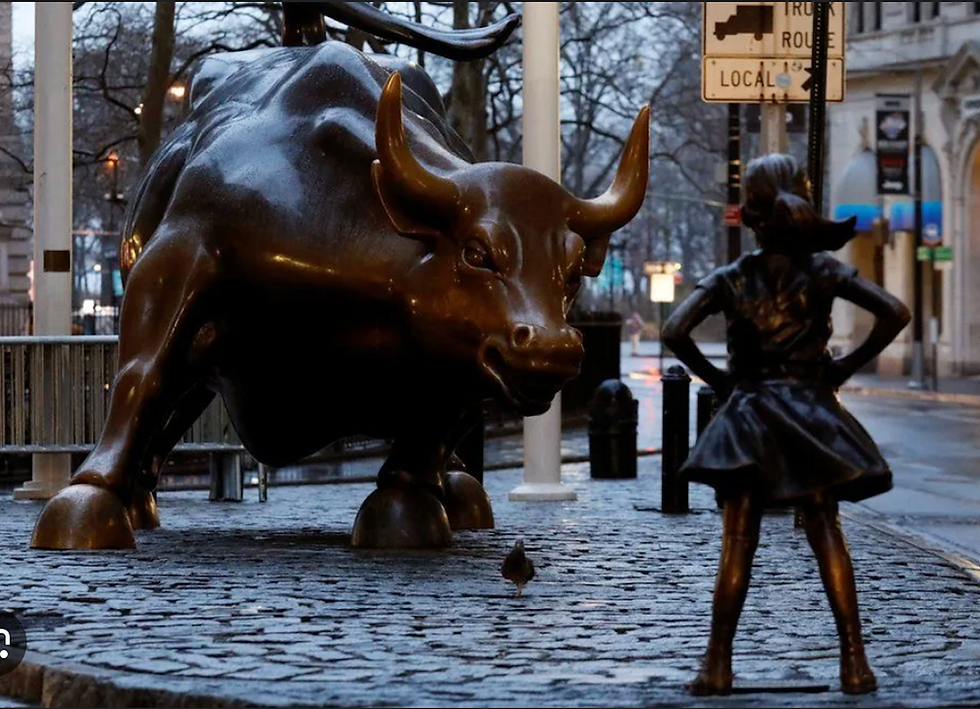
That decision transformed everything.
The bull, created by Arturo Di Modica, was intended as a symbol of resilience—strength in the aftermath of the 1987 crash. But when the girl appeared in front of it, the narrative shifted almost instantly.
What had been a symbol of recovery began to read as a symbol of pressure.
And the girl? She wasn’t just present—she was opposing.
That reinterpretation wasn’t accidental. It was strategic, visual storytelling at scale. A single image—widely photographed and shared—reframed the meaning of a sculpture that had stood for decades.
It’s rare for one piece of public art to so quickly alter the perception of another.
This one did.
Standing by these two statues is one of the most interesting moments on a Wall Street walk. Because depending on how you look at it, you’re either seeing a powerful statement—or a very strategic piece of marketing.
The Message vs. The Criticism
The public response was immediate and, in many cases, enthusiastic. Fearless Girl became an icon almost overnight.
But the reception wasn’t universally positive.
From an artistic standpoint, Di Modica argued that the statue distorted the intent of his work. From his perspective, the bull was never meant to represent aggression or threat, and placing the girl in opposition to it fundamentally changed that meaning.
From within finance, the criticism took a different form.
Observers pointed out that State Street Global Advisors—the firm behind both the statue and the ETF—was promoting gender diversity externally while still facing its own internal challenges around representation and equity.
That tension is important.
Because Fearless Girl sits at the intersection of three forces that don’t always align cleanly:
Advocacy
Marketing
Corporate strategy
She is, at the same time, a symbol with cultural weight and a campaign with a measurable objective.
The ETF Behind the Statue: SHE
The SHE ETF is where the symbolism becomes operational.
Unlike the statue, which communicates through emotion and imagery, the ETF functions within the mechanics of the market. It tracks an index of U.S. companies that score highly on gender diversity in senior leadership roles.
The underlying thesis is clear: representation at the top influences decision-making, and better decision-making drives stronger outcomes over time.
That idea has been explored across institutional research, consulting reports, and corporate governance studies. While the results vary depending on methodology, the broader direction is consistent—diversity is increasingly viewed not just as a social goal, but as a performance factor.
At the same time, it’s important to stay grounded in what the ETF actually is.
It’s not a guarantee of outperformance. It’s not immune to market cycles. And it doesn’t exist outside the constraints of index construction and sector exposure.
It’s a tool—one that allows investors to align capital with a specific thesis.
Why the Statue Resonated
Fearless Girl succeeded because it translated something complex into something immediate.
Most people don’t engage deeply with corporate governance metrics or index methodologies. But they understand posture. They understand stance. They understand what it looks like to hold your ground.
The statue distilled multiple layers—finance, representation, power structures—into a single, readable moment.
And that’s why it spread.
Not because it simplified the issue completely, but because it made it accessible.
A Personal Lens: Strength I Didn’t Have—At First
This is where it becomes personal for me.
I didn’t professionally enter the markets early, even with proximity to Wall Street and a family deeply connected to it. And the reason wasn’t a lack of exposure or understanding—it was hesitation.
Because the inequity wasn’t subtle.
It showed up in who was in the room, who had access, and who moved forward within the system. Even from the outside, those patterns were visible enough to shape how I saw the industry.
So I kept my distance.
I paid attention. I learned. I invested from afar, but I didn’t step in.
Looking back, I can recognize that what I was missing wasn’t knowledge or capability. It was something closer to what the statue represents.
Not confidence in the traditional sense—but the willingness to participate anyway.
To step into a system that didn’t feel like it was designed with me in mind.
That’s what makes Fearless Girl resonate with me now.
Not because she represents a reality that already exists—but because she represents the decision to engage before it does.

Repositioning and Permanence
In 2018, the statue was relocated from its original position in front of the bull to a new site facing the New York Stock Exchange. (Can the public go inside the NYSE? Read more here)
That shift changed the framing once again.
Without the bull directly in front of her, the message became less about confrontation between two symbols and more about direction. She now faces the institution itself—the structure that defines the market.
It’s a quieter statement, but in some ways a more direct one.
What She Represents Now
Fearless Girl is often described as a symbol of empowerment, and that’s not incorrect. But it’s incomplete.
She represents pressure on institutions to evolve. She represents the growing role of capital in shaping corporate behavior. And she reflects the reality that change often begins externally—through demand, visibility, and accountability—before it becomes internal.
On an individual level, though, the meaning can be simpler.
It comes down to a decision.
To step forward, even when the system feels imperfect.To participate, even when the path isn’t clearly defined.
Not because the conditions are ideal.
But because waiting for them to be means never entering at all.
In Summary
The Fearless Girl isn’t just a statue—it’s a conversation.
About power, about perception, and about who gets to define the narrative of Wall Street.
And like a lot of things in this part of the city, the story isn’t as simple as it first appears.
Like the Charging Bull, Fearless Girl operates on multiple levels—as public art, as corporate messaging, and as a cultural symbol shaped by interpretation over time.
But her staying power comes from something more grounded.
She doesn’t represent fearlessness as a fixed trait.
She represents it as a choice.
One that, for me, didn’t happen early—but happened eventually, and that’s what makes her meaningful.
If you want to see how these two sculptures reshape each other in real time, you can experience it on our Wall Street walking tour or check out our Complete Guide to Lower Manhattan.
Updated April 22, 2026


