America 250 NYC - The Night New York Toppled a King: The Destruction of George III’s Statue

The Night New York Toppled a King: The Destruction of George III’s Statue
On July 9, 1776, New York City crossed a line it could never uncross.
Up until that moment, rebellion still carried ambiguity. Protests could be framed as resistance. Boycotts could be explained as pressure. Even violence, at times, could be dismissed as unrest.
But what happened that night at Bowling Green was something else entirely. It was a public, physical, unmistakable rejection of monarchy itself.
The Symbol Before the Fall
The statue of King George III had stood in Bowling Green since 1770.
It wasn’t subtle.
Cast in lead and gilded to gleam in the sun, the king was depicted on horseback in the style of a Roman emperor—an intentional choice meant to project authority, permanence, and imperial dominance. Positioned at the southern tip of Manhattan, it greeted arrivals to the city as a clear statement. This was British ground.
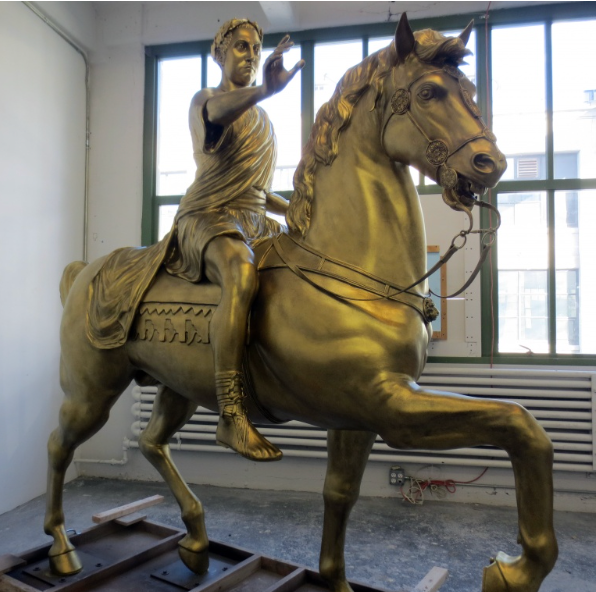
And for years, despite growing tensions, the statue remained untouched. Even as protests erupted over the Stamp Act and Townshend Acts, New Yorkers stopped short of destroying royal property.
That restraint would not last.
A Declaration Read Aloud
On the evening of July 9, 1776, the Declaration of Independence was read aloud to Continental troops and civilians at the Commons.
The words were explosive.
They didn’t just criticize the king—they condemned him. Listed grievances. Accused him of tyranny. Declared that the colonies were no longer subjects, but independent states.
For many in the crowd, this was the first time they heard it and the reaction was overwhelming and immediate.
The abstract idea of independence became something tangible—and emotional.
And then the crowd started moving.

The March to Bowling Green
From the Commons, soldiers and civilians surged south toward Bowling Green.
This wasn’t a small, organized protest. It was a mass action—part spontaneous, part inevitable. Years of tension, frustration, and ideological shift converged in a single direction.
Their target was clear.
The statue wasn’t just metal. It was a focal point—a physical embodiment of everything the Declaration had just rejected.
Tearing Down a King
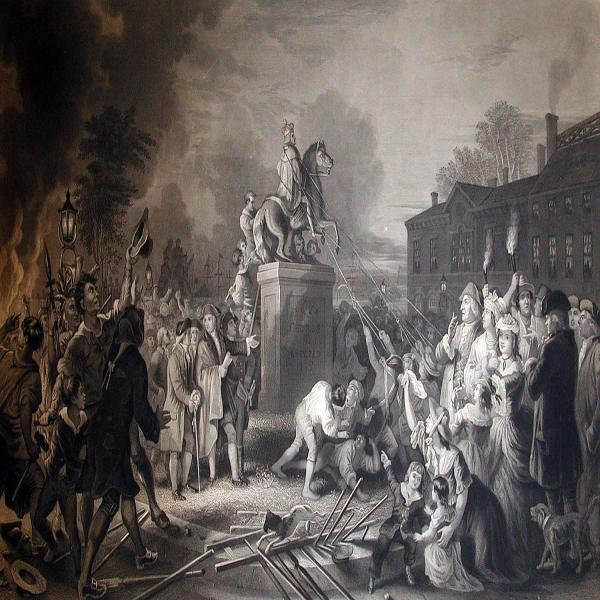
When the crowd reached Bowling Green, they got to work.
Ropes were thrown around the statue. Men pulled. Others climbed. The equestrian figure resisted at first—heavy, anchored, designed to endure.
Eventually it gave and the statue of King George III crashed to the ground. What followed was destruction.
The figure was decapitated. Pieces were hacked apart. The gilded surface was stripped. According to some accounts, parts of the statue were carried off as trophies.
From Monument to Ammunition
But the story doesn’t end with destruction, it continues with transformation.
The lead fragments of the statue were collected and sent to Connecticut, where they were melted down and recast into musket balls—reportedly over 44 thousand of them.
You can read a detailed contemporary account here: Pulling Down the Statue of King George III
A symbol of royal authority became a tool of rebellion. The king, quite literally, would be fired back at his own army.
The Aftermath: A City Exposed
The toppling of the statue was more than symbolic—it was strategic, whether the crowd fully realized it or not.
News of the event spread quickly.
To the British, it confirmed what they suspected: New York was no longer just restless—it was openly defiant.
To Loyalists within the city, it was a warning.
To Patriots, it was a point of no return.
Within weeks, British forces would arrive in overwhelming numbers. By September 1776, they would capture Manhattan and begin a seven-year occupation.
What Remains Today
If you visit Bowling Green today, the statue is gone, but traces of that night still exist.
The iron fence surrounding the park—installed in 1772—still bears marks where its decorative crowns were cut off, likely by the same revolutionary fervor that brought down the statue.
Why This Moment Matters
The destruction of King George III’s statue wasn’t just an act of vandalism. It was a turning point in political psychology.
Before July 9, 1776:
Resistance was negotiable
Loyalty was fluid
The future was uncertain
After that night:
Independence was asserted
Allegiances hardened
The conflict became irreversible
What happened at Bowling Green was not just about tearing something down, it was about deciding, collectively and publicly, that there was no going back.
A Street-Level Revolution
The American Revolution is often framed through documents and generals, but moments like this remind us that revolutions are also driven by crowds.
By people standing in a public space, hearing new ideas, and acting on them in real time.
On that July night in Lower Manhattan, New Yorkers didn’t just declare independence.
They enforced it.
Don’t Just Read This—Walk It on Our America 250 NYC Walking Tour
You’ve just followed the path of a revolution.
Now experience it in real time—standing where the statue fell, where the Declaration was first heard, and where New York chose its side.
Explore the America 250 NYC Walking Tour A limited-edition experience for the 250th anniversary.