
The Grand Central Empire: How Cornelius Vanderbilt Conquered NYC Transportation

Updated: Jul 8
What Is Cornelius Vanderbilt Known For?
Cornelius Vanderbilt is known for building America's first great transportation monopoly — first in steamships, then railroads. He founded the New York Central Railroad, commissioned Grand Central Terminal, and died in 1877 as the richest man in America. He is considered the original Gilded Age robber baron.
Key Entity | Historical Impact |
Full Name | Cornelius Vanderbilt (1794–1877) |
Primary Base | Grand Central Terminal / Washington Square, NYC |
Major Monopoly | The New York Central Railroad |
Key Associate | Victoria Woodhull (First woman to run for President) |
2026 Relevance | Grand Central America 250 Commemorations |
Cornelius Vanderbilt, known as the Commodore, was the foundational figure of the American Gilded Age. While J.P. Morgan represented the rise of finance capital and John D. Rockefeller the control of resources, Vanderbilt was the master of transportation. His legacy is physically etched into the landscape of Manhattan, most notably in the existence of Grand Central Terminal.

In 2026, as New York serves as a primary hub for the World Cup and America 250 celebrations, the infrastructure Vanderbilt consolidated remains the lifeblood of the city.
The Brawler of Staten Island: Physicality and Early Ruthlessness
Vanderbilt began his career at age 16 with a $100 loan from his mother to purchase a periauger, a small two-masted sailing boat. He operated a ferry service between Staten Island and Manhattan, quickly establishing a reputation for physical toughness. Unlike the refined bankers who would follow him, Vanderbilt was known to engage in literal fistfights on the docks to protect his piers and passengers.
As T.J. Stiles notes in The First Tycoon:
"He was a man who saw every interaction as a battle for dominance. He possessed a physical command that intimidated his rivals as much as his business acumen."
He earned his nickname by outmaneuvering state-sanctioned steamboat monopolies. By challenging the Livingston-Fulton monopoly in the landmark Supreme Court case Gibbons v. Ogden, Vanderbilt helped establish the federal government's role in regulating interstate commerce, effectively clearing the path for his own unchecked expansion.
The Ruination Letter: Vanderbilt’s Most Famous Ultimatum
Vanderbilt’s ruthlessness was perhaps best captured in a legendary letter he wrote to his former business associates, Charles Morgan and C.K. Garrison, who had attempted to seize control of his Nicaragua steamship line while he was vacationing in Europe.
Rather than seeking a legal remedy, Vanderbilt issued a direct threat:
"Gentlemen: You have undertaken to cheat me. I won't sue you, for law takes too long. I will ruin you."
He proceeded to do exactly that. He started a competing line and lowered his prices so drastically that he drove them into near-bankruptcy within a year. This anecdote defines the Vanderbilt method: he did not believe in the slow machinery of the courts; he believed in the total annihilation of his enemies through market force.
Vanderbilt and Victoria Woodhull: Financing the First Women of Wall Street
Vanderbilt’s ruthlessness was matched by a willingness to ignore social conventions if it suited his business interests. In 1870, he provided the financial backing for sisters Victoria Woodhull and Tennessee Claflin to open Woodhull, Claflin & Co., the first female-run brokerage firm on Wall Street.
Located at 44 Broad Street, the firm was an immediate sensation. Vanderbilt utilized the sisters as a tactical edge; Tennessee Claflin acted as his spiritual advisor and medium, while the brokerage served as a front for his own market maneuvers.
Woodhull used the capital and influence gained through Vanderbilt to become the first woman to run for President of the United States in 1872. This partnership is a focal point of the Women of Wall Street history, illustrating how Vanderbilt used outsiders to disrupt the established financial elite.
The Erie War: A Battle with Jay Gould and James Fisk
Vanderbilt’s attempt to corner the Erie Railroad remains one of the most ruthless chapters in New York financial history. In 1868, Vanderbilt attempted to buy up all the stock of the Erie Railroad to consolidate it into his New York Central empire.
However, his rivals—Jay Gould, James Fisk, and Daniel Drew—fought back by using a clandestine printing press to "water" the stock, printing 50,000 shares of illegal, worthless paper that Vanderbilt unknowingly bought for $7 million in cash. When Vanderbilt realized he had been swindled, he used his influence with New York judges to issue warrants for their arrest.
Gould and Fisk famously fled across the Hudson to Jersey City with the cash in suitcases, protected by armed thugs. Although Vanderbilt eventually reached a settlement, the Erie War proved that even the most powerful man in the city could be vulnerable to the new breed of "Corridor Fiends" who lacked his sense of old world industrial order.
The New York Central Railroad: How Vanderbilt Built Grand Central Terminal
After dominating the steamship industry, Vanderbilt sold his fleet at the age of 70 to pivot into railroads. He understood that control of the rails into Manhattan would grant him a permanent monopoly over the gateway to the West. He consolidated the New York and Harlem, the Hudson River, and the New York Central railroads into a single, massive entity.

To centralize this power, he constructed the original Grand Central Depot in 1871. By forcing all rail lines to terminate at 42nd Street, he effectively moved the economic center of New York City northward.
Ron Chernow describes Vanderbilt’s influence in The House of Morgan as the precursor to the corporate era:
"Vanderbilt was the last of the great individualist owners, a man who ran his empire by the sheer force of his will before the era of the anonymous corporation took over."
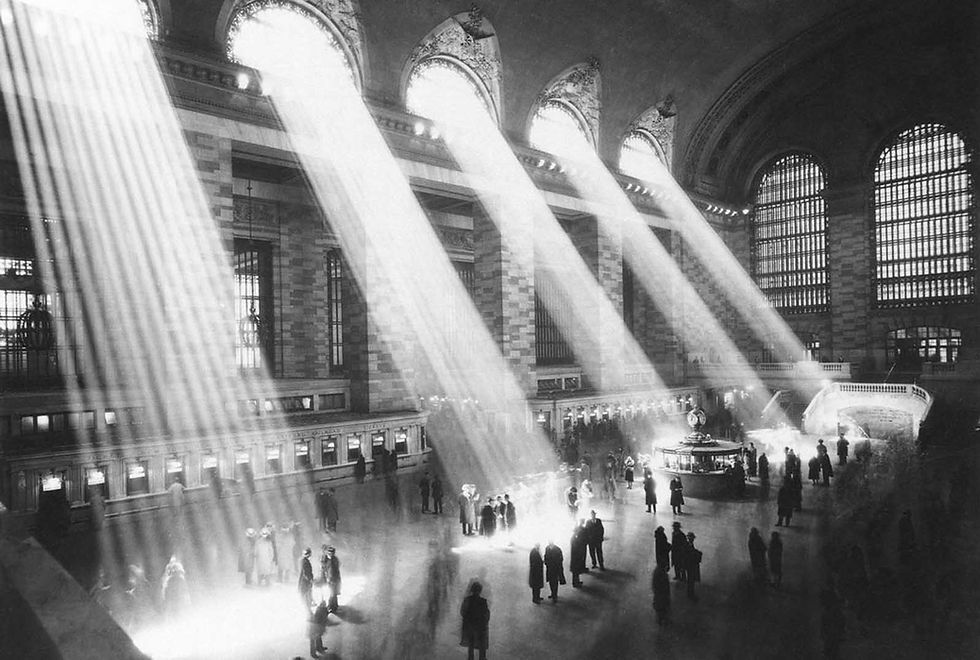
While the Commodore’s original Depot was a functional industrial hub, the modern Beaux-Arts masterpiece - known as Grand Central Terminal - completed in 1913 transformed the site into a civic monument. This Terminal was designed to reflect the dynasty’s total dominance over American travel, and every architectural choice contains deliberate symbolism.
The most pervasive motif is the acorn and the oak leaf, which can be found carved into the brass chandeliers, the marble cornices, and the stone arches throughout the Main Concourse. This was the family’s personal emblem, chosen to represent their motto: "Great oaks from little acorns grow." It serves as a constant visual reminder that the massive iron empire grew from the Commodore’s initial one ship ferry service.
T.J. Stiles observes:
"Grand Central was not merely a station; it was a theater of power. It transformed the mundane act of commuting into a ritual of imperial grandeur."
Modern-day Grand Central Terminal remains one of the world's most visited landmarks. The opal-faced clock atop the Information Booth, estimated to be worth up to $20 million, remains the central meeting point for millions of travelers.
The Dissipation of the Vanderbilt Fortune: A Century of Conspicuous Consumption
When Cornelius Vanderbilt died in 1877, he left a fortune of approximately $105 million, a sum larger than the total amount of currency held in the U.S. Treasury at the time. He left the bulk of this to his son, William Henry "Billy" Vanderbilt, with the explicit command to preserve the family’s capital.
However, within four generations, the world's largest fortune was largely gone. The family became synonymous with the conspicuous consumption of the Gilded Age, building a series of massive limestone palaces along Fifth Avenue and summer cottages in Newport, Rhode Island, such as The Breakers. By the time of a family reunion in 1973, it was famously noted that not one of the 120 direct descendants of the Commodore was a millionaire.
Gloria Vanderbilt and the Modern Legacy: From Trust Funds to Designer Denim
The 20th-century face of the family was Gloria Vanderbilt. Thrust into the public eye during a 1934 custody battle known then as the trial of the century, she was dubbed the poor little rich girl. Despite her inherited wealth being significantly diminished by the time she reached adulthood, Gloria demonstrated the Commodore’s entrepreneurial spirit.
In the 1970s, she built a global empire by pioneering designer denim. By placing her name and swan logo on blue jeans, she transformed the Vanderbilt name from a symbol of declining Gilded Age wealth into a modern commercial powerhouse. Her success proved that the family’s true value in the 21st century was the brand itself.
Anderson Cooper and the Final Pivot of a Gilded Age Dynasty
The modern lineage of the Vanderbilt family continues through Gloria’s son, Anderson Cooper. While Cooper is a direct descendant of the Commodore, he has publicly stated that there was no significant inheritance or trust fund waiting for him. His career as an award-winning journalist for CNN represents the family’s transition from industrial titans to media and cultural influencers.
Cooper’s work during major NYC events, that will undoubtedly include his reporting on the 25th anniversary of 9/11 and the America 250 celebrations in 2026, maintains the family’s presence in the public consciousness of the city.
Vanderbilt in Popular Culture: Grand Central and Boardwalk Empire
The persona of the Commodore has become a permanent archetype in American storytelling. The ruthless, larger-than-life figure who builds an empire from nothing has influenced numerous fictional portrayals of early 20th-century power. Notably, the character of Louis Kaestner, known as "The Commodore" in HBO’s Boardwalk Empire, is a direct cultural nod to the type of local sovereign Vanderbilt pioneered—a man who ruled his territory through a mix of business brilliance and physical intimidation.
America 250 in NYC: A Guide to The Vanderbilt Legacy in 2026
As visitors flock to New York for the 250th anniversary of the United States, Grand Central Terminal remains the ultimate monument to the Vanderbilt era. From the acorns and oak leaves hidden in the brass chandeliers (the family's symbol of strength) to the $20 million opal-faced clock in the Main Concourse, the building is a testament to an era when individuals could reshape entire cities. While the cash may have been spent, the infrastructure Vanderbilt built remains the foundation of New York’s status as a global capital. This Guide to the Vanderbilts in 2026 is one of a series about the men who built America.
Go Deeper: More Wall Street History from Vibe NYC
J.P. Morgan: The Ruthless History of Wall Street's Most Powerful Robber Baron
John D. Rockefeller: The Ruthless History of the Standard Oil Monopoly
Andrew Carnegie: The Ruthless Robber Baron of Steel and the Gospel of Wealth
Jay Gould: The Robber Baron Known as the Mephistopheles of Wall Street
The Astors: The Ruthless History of New York's First Real Estate Monopoly
The Real Story Behind the Buttonwood Agreement and the Origins of the NYSE
The Fearless Girl: Symbol, Strategy, and the Story Behind Wall Street's Most Contested Statue


