
Christmas Fairs in NYC: How German Immigrants Invented the Holiday Market
- Dana at Vibe Tours

- May 24
- 5 min read
Every December, New Yorkers and visitors crowd the wooden stalls of Bryant Park and Union Square, sipping hot cider and browsing handmade goods. The Christmas fairs of NYC feel like permanent fixtures of the city — ancient, inevitable. What most people don't know is that they have a specific origin, a specific community, and a specific moment in history when they arrived in New York.
What Are Christmas Markets — And Where Did They Come From?
Christmas markets — Weihnachtsmärkte — have existed in German-speaking Europe since the late Middle Ages. The earliest recorded market dates to Dresden in 1434. By the 19th century they were a defining feature of German city life: outdoor stalls selling food, handmade crafts, wooden decorations, and the specific category of goods — candles, carved figures, glass ornaments — that we now associate universally with Christmas. The German Christmas market tradition is, in other words, the direct ancestor of every holiday market in New York City today.
New York's Christmas market tradition didn't emerge in isolation — it arrived as part of a centuries-old European culture of winter markets, two of which predate Columbus's arrival in America.
The Vienna Christkindlmarkt traces its origins to 1296, when Duke Albrecht I granted Vienna’s citizens permission to hold a December market known as the “Krippenmarkt,” making it one of Europe’s oldest documented Christmas markets. (Christkindlmarkt)
Meanwhile, Nuremberg Christkindlesmarkt is traditionally dated to 1628, based on the earliest surviving written reference to a “Kindles-Marck” preserved on a decorative wooden box in the Germanisches Nationalmuseum. (Nuremberg Tourism)
How German Immigrants Brought the Holiday Market to New York
In the 1840s and 1850s, waves of German immigrants arrived in New York City, settling primarily in what is now the East Village and the area known then as Kleindeutschland — Little Germany — stretching along the Lower East Side. They brought with them the customs they had grown up with: the decorated tree (itself a German invention, popularized in England by Prince Albert), the Advent calendar, the handcrafted ornament, and the outdoor Christmas market.
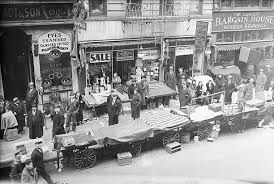
By the mid-19th century, German vendors had established Christmas market stalls on the Lower East Side, selling decorations, toys, and food — roasted chestnuts, stollen, pfefferkuchen. These were neighborhood events, not tourist attractions, serving the immigrant community that had created them.
By the mid-nineteenth century, German Christmas traditions were already firmly embedded in Lower Manhattan immigrant life. The New-Yorker Staats-Zeitung — founded in 1834 and later one of New York’s most influential daily newspapers — regularly chronicled the social life of Kleindeutschland. Surviving archives suggest that by December 1858 the paper was already documenting seasonal markets, holiday gatherings, and German Christmas customs on the Lower East Side, providing a rare primary-source window into immigrant holiday culture in pre–Civil War New York.
At its height, Kleindeutschland was one of the largest German-speaking urban enclaves in the world outside Europe, and the Staats-Zeitung functioned as both its newspaper of record and cultural connective tissue.
How the German Christmas Tradition Became New York's Christmas Tradition
The tradition spread gradually into the broader culture of New York City. By the late 19th century, department stores — themselves largely founded by German Jewish immigrants like Benjamin Altman, who founded B. Altman on Sixth Avenue in 1865, and the Bloomingdale brothers, Lyman and Joseph, who opened their first store on the Lower East Side in 1861 — had absorbed the German gift-giving tradition into their Christmas retail strategies.
The decorated window display, the toy department, the Christmas catalogue: all of these trace a direct line back to German immigrant culture in Lower Manhattan. Even Irving Berlin's White Christmas, the song that defined the American holiday for a generation, came from a Jewish immigrant shaped by this same New York milieu.

Bryant Park, Union Square, and the Living Legacy of NYC's Christmas Fairs
New York’s modern holiday markets owe as much to European Christmas traditions as to local retail culture. Two of the city’s best-known examples — Union Square Holiday Market and Bryant Park Winter Village — consciously borrow from the centuries-old Christkindlmarkt model popularized in German-speaking Europe.
The Union Square Holiday Market is the elder of the two. It was founded in 1993 by British urban planner Eldon Scott and his company Urban Space Management (later Urbanspace), helping introduce the European-style holiday market concept to modern New York. Today it is one of America’s largest seasonal markets, typically featuring 150–185 vendors selling artisan goods, gifts, jewelry, food, and holiday décor. (Union Square Holiday Market) (FSR Magazine)
Bryant Park’s Holiday Shops / Winter Village opened later, in 2002, inspired explicitly by Europe’s Christmas markets as part of an effort to activate Bryant Park during the winter season. The market was not originally operated by Urbanspace; Bryant Park Corporation brought Urbanspace in as operator in 2016. Since then, the market has expanded dramatically, growing from about 80 boutiques in its inaugural 2002 season to roughly 170–200 vendors in recent years, making it one of Manhattan’s largest holiday shopping destinations. (Wikipedia) (Urbanspace Markets)
Hester Street Fair Holiday Market at the Seaport adds a downtown Lower Manhattan counterpart to the larger Midtown markets. Operated by Hester Street Fair at 18 Fulton Street, the holiday market typically runs from late November through Christmas Eve and focuses on independent local makers, artists, designers, and food vendors. Vendor participation varies seasonally but generally ranges from several dozen rotating merchants and pop-ups throughout the season. (Hester Street Fair)
Together, the three markets create a layered geographic holiday circuit:
Union Square channels the dense urban energy of downtown Manhattan,
Bryant Park delivers the grand European-style winter village atmosphere in Midtown,
and the Seaport market adds cobblestone waterfront nostalgia beside some of the city’s oldest surviving streets.
That combination — lights, temporary wooden stalls, cider stands, skating rinks, handmade ornaments, waterfront fog, and cold-weather crowds — is what increasingly defines New York’s modern “atmosphere of December.”
These markets also sit atop an older, often overlooked layer of New York Christmas history: Kleindeutschland (“Little Germany”), Manhattan’s once-massive German immigrant enclave. In the nineteenth century, Kleindeutschland stretched roughly from 4th Street to 14th Street, east of Third Avenue, encompassing parts of today’s East Village and Lower East Side. German immigrants brought with them traditions including Christmas trees, Advent customs, beer halls, holiday baking, and open-air winter celebrations that helped shape American Christmas culture long before Rockefeller Center or modern holiday pop-ups existed.
The Christmas fairs of NYC have become so embedded in the city's identity that their origins feel invisible. But origins matter — they give the tradition weight, and they tell a larger story about what New York has always done best.
The stall you're browsing in Bryant Park this December sits on a tradition that traveled from Dresden in 1434, through the streets of Kleindeutschland, into the city you're standing in. That's worth knowing.
Explore the immigrant histories behind New York's most beloved December traditions with Vibe NYC Tours — our Lower Manhattan Christmas experience goes deeper than any guidebook.


